

Traders begin with a demo trading account to gain expertise and confidence without risking real money. For beginners exploring copy trading practice, a virtual trading account is a surefire way to test how signal providers perform. A social trading demo helps users understand the platform and strategy before going live. This article covers how demo accounts support smart trading decisions and prepare users for real-market copy trading.
What is a Copy Trading Demo Account?
A trader in the financial market is successful if he has received the essential fundamental training and abilities before beginning work; otherwise, he will experience so many losses in the financial markets that he will lose motivation to continue and stay in it. As a result, brokers have included a function for beginners that allows them to use the tool to evaluate their ability to predict trades, thus increasing their skill and experience in chart interpretation and prediction skills through practical, trial-and-error learning. This tool is named “Demo accounts.”
That said, a copy trading demo account is a simulated trading environment that lets users experience copy trading without using real money. It functions as a simulated copy trading platform, letting users replicate the trades of professional traders without using real capital. Demo accounts are available from a wide range of online trading platforms, including stock exchanges, foreign exchange trading venues, and commodities markets.
Paper trading is often mentioned alongside copy trading, but the two are quite different in how they function and serve traders. Paper trading does not involve copying trades from other traders. In paper trading, users simulate placing their own trades using virtual money to test strategies, learn how the markets work, or gain confidence without any financial risk. The key difference lies in control and intention: copy trading (even in demo mode) is passive and reliant on another trader’s decisions, while paper trading is active and driven by the user’s own analysis. Both serve as educational tools, but copy trading demos teach users how to follow traders, whereas paper trading builds personal trading skills.
How Does Copy Trading Work on a Demo Account?
Copy trading on a demo account allows users to experience the functionality of live copy trading without risking real money. The procedure involves choosing a professional trader, also known as a signal provider, from a list on the platform that includes information about each trader’s trading style, risk tolerance, and performance history. After a user selects a trader to follow, they allocate a portion of their virtual funds to automatically mirror the trader’s positions.
The platform then uses real-time market data to simulate trades – whenever the trader opens, modifies, or closes a position, the same action is executed in the user’s demo account proportionally, based on the amount allocated. Users can typically customize settings such as copy ratio, maximum loss limits, and whether to copy all open trades or only new ones.
While no real money is involved, the technical structure mirrors live copy trading. In this way, users can test different strategies, monitor performance, and refine risk management techniques.
Pros and Cons of Copy Trading on a Demo Account
The following are the benefits of copy trading practice along with its disadvantages on a demo account.
Pros
- Practice without risking real money.
- Test trader strategies safely.
- Build confidence as a beginner.
- Try different settings and combinations.
- No financial loss from mistakes.
Cons
- Doesn’t reflect real emotional pressure.
- Trade execution may differ from live accounts.
- No real profits gained.
- May encourage unrealistic risk-taking.
- Strategy performance may not match live results.
- Risk of overconfidence before going live.
Best Copy Trading Platforms with Demo Accounts in 2026
Given below is the overview of different copy trading platforms with demo accounts in greater detail.
| Brokers | Regulators | Copy Trading | Leverage | Platforms | Minimum Deposit |
| AvaTrade | ASIC, FSCA, FSA, FFAJ, ADGM-FSRA, ISA, and KNF. | DupliTrade and AvaSocial. | 1:400 for forex pairs. | DupliTrade, AvaSocial, MT4, MT5, and Capitalise.ai. | $100. |
| Pepperstone | ASIC, FCA, CySEC, CMA, SCB, and BaFin. | MT4 & MT5. | 1:500 for forex pairs. | MT4, MT5, and cTrader. | none. |
| eToro | FCA, ASIC, CySEC, FinCEN, MFSA, ADGM, FSRA, FSMR, FSAS, and FinCEN. | CopyTrader. | 1:500 for most forex pairs. | eToro Proprietary trading platform. | $10. |
| FPMarkets | ASIC, CySEC, FSCA, and FCA. | MT4 & MT5. | 1:500 for forex pairs. | MT4, MT5, Iress Essential, Web Trader, and cTrader. | $100. |
| Naga | CySEC | AutoCopy feature on NAGA. | 1:500 for forex pairs. | NAGA, MT4, and MT5. | $10. |
AvaTrade: Best Copy Trading Platform for Regulated Trading
Avatrade is a well-regulated broker overseen by multiple financial authorities, such as ASIC (Australia), the Central Bank of Ireland, FSCA (South Africa), and others. It offers social trading demo accounts through third-party platforms like DupliTrade and through its in-house platform, AvaSocial. While there are no extra fees charged directly by AvaTrade, users must meet minimum deposit requirements (e.g., $2,000 for DupliTrade) and may incur provider-based costs. AvaTrade provides the best copy trading demo account with $10,000 in virtual funds, which supports trading through MT4/MT5 and its AvaTradeGO app. The platform is intuitive but it’s better suited for intermediate users. The broker has strong educational offerings through Ava Academy, featuring webinars, courses, and market analysis.

Pros
- Regulated in multiple regions.
- Supports social trading demo accounts via DupliTrade and AvaSocial.
Cons
- Some third-party copy platforms require a minimum deposit.
- Fees vary depending on the copy trading provider used.
Pepperstone: Best Copy Trading Platform with Low Fees
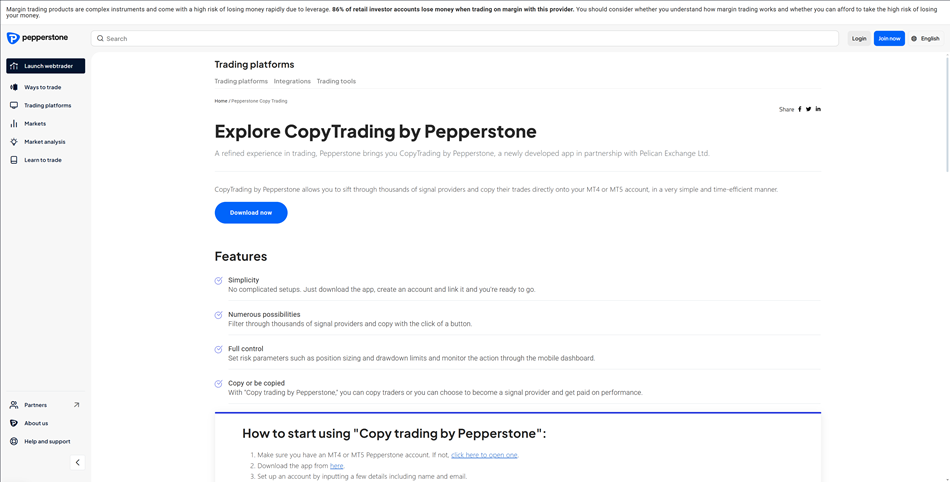
Pepperstone is licensed by top regulators like ASIC, FCA, BaFin, DFSA, and CySEC, and offers multiple copy trading solutions, including Myfxbook AutoTrade, MetaTrader Signals, and DupliTrade. It charges no additional copy trading fees beyond regular spreads or commissions depending on the account type (Standard or Razor). Pepperstone offers access to a copy trading platform with a no deposit demo, which is available for 30 days with $50,000 in virtual funds. The broker supports MT4, MT5, and cTrader platforms. The platform not only provides fast execution but also offers advanced charting tools and indicators. Pepperstone also shines in education as it offers educational webinars, informative articles, and market insights.
Pros
- Regulated by top-tier authorities.
- Fast execution with low spreads and deep liquidity.
- Offers copy trading through trusted integrations, giving more control.
Cons
- No proprietary copy trading platform.
- Limited social trading features (no feed or in-app leaderboards).
eToro: Best Copy Trading Platform for Social Trading
eToro stands out with its proprietary CopyTrader system and is heavily regulated under the FCA (UK), ASIC (Australia), CySEC (Cyprus), and FinCEN (USA). Unlike many brokers, eToro integrates copy trading practice directly into its platform so that users can mimic top traders with full transparency and social interaction. There are no additional costs for copy trading, though spreads tend to be higher. An unlimited demo account with $100,000 virtual funds is available. The interface is extremely user-friendly, especially for beginners. eToro also offers Smart Portfolios for thematic investing. Its educational resources, including eToro Academy and daily analysis, are extensive and accessible. You can use eToro’s copy trading sandbox mode to practice copying top traders’ strategies in a risk-free environment before committing your hard-earned money.

The pros include a seamless and social copy trading experience, diverse assets (stocks, crypto, forex), and transparent trader stats. However, its drawbacks are limited platform customization, higher-than-average spreads, and no access to MT4/MT5.
Pros
- Proprietary, all-in-one copy trading platform.
- Transparent trader profiles with in-depth stats.
- No management fees.
- Profits are performance-based.
Cons
- Spreads can be comparatively higher.
- Limited control over individual trades once copying begins.
- Not ideal for scalping strategies.
FPMarkets: Best Copy Trading Platform for Advanced Traders
FP Markets is a reputable broker regulated by ASIC, CySEC, and FSCA. It supports virtual copy trading through platforms like Myfxbook AutoTrade, MetaTrader Signals, and its own mobile copy trading app. There are no additional fees from FP Markets itself, though signal providers may charge their own commissions. A 30-day demo account is available, and trading is supported via MT4, MT5, and the IRESS platform.

The interface is customizable and offers professional-level tools, which may be better suited to experienced traders. The platform offers a huge collection of educational resources including eBooks, video tutorials, articles, webinars and podcasts.
Pros
- Offers copy trading via MT4/MT5, Myfxbook AutoTrade, and FP Markets Social Trading App.
- Access to high leverage and tight spreads.
- Supports algorithmic strategies.
- You can follow multiple traders with different styles.
Cons
- The interface may be less intuitive for newbies.
Naga: Best Copy Trading Platform for Beginners
NAGA is a regulated and user-friendly platform offering a unique copy trading practice model that blends social networking with financial trading. The platform is regulated by CySEC, BaFin, and compliant with MiFID II. Users can automatically copy top traders on the platform across assets like forex, stocks, crypto, and more. The platform features a transparent leaderboard and real-time analytics.
Copy trading fees are straightforward: users typically pay $0.99 per profitable copied trade, and there are no management fees, making it performance-based. NAGA also provides a free demo copy trading account that mirrors live market conditions. Its interface is intuitive and accessible via web and mobile apps.

Educational resources on NAGA include webinars, articles, tutorials, and strategy breakdowns that are integrated into the platform. Users can also explore detailed trader profiles with historical performance and strategy overviews. Some users may find the per-trade fee structure costly with high trade frequency.
Pros
- One-click auto-copy.
- Social feeds and leaderboards promote community learning.
- Traders earn copy bonuses.
Cons
- Limited customization in advanced risk management settings.
- Wider spreads.
- No fixed monthly pricing – costs depend on trade activity.
How to Use a Copy Trading Simulator
Here’s a step-by-step guide on how to do simulated copy trading.
1. Choose a Copy Trading Platform
Select a broker or platform that offers demo-based copy trading. Check if it includes a no-deposit demo account.
2. Register for a Demo Account
Open a virtual trading or demo account on the platform you’ve chosen. You only need to provide your email and basic info – no payment or deposit is needed.
3. Browse Top Traders or Signal Providers
Go to the copy trading section and explore available traders based on their stats like return rate, risk score, trading history, and asset preference.
4. Select a Trader to Copy
Choose one or more traders you want to simulate copying.
5. Adjust Copy Settings
Set how much of your virtual capital to allocate, whether to copy open trades and customize risk controls. Some platforms let you mirror trades proportionally.
6. Monitor Performance in Real Time
Watch your practice copy trading account as it mirrors the trader’s moves. The platform will automatically update your virtual balance based on performance.
7. Analyze Results
Review performance reports, win/loss ratios, and drawdowns. Use this to evaluate the strategy and adjust copy settings or traders as needed.
8. Decide When You’re Ready to Go Live
Once confident, you can transition from a demo to a live account. Start small and apply the same risk management strategies you practiced in the simulator.
Demo Copy Trading Vs Real Copy Trading
When we talk about demo vs real copy trading, the primary distinction between the two is that real accounts trade with real money, while demo accounts trade with virtual money that has no real value. Except for real and virtual funds, demo accounts have the same market conditions as actual accounts.
Furthermore, using a demo account for a set length of time may help in the learning of necessary trading skills. You will inevitably lose money as you learn all of the trading intricacies. Let it be virtual instead of real.
When learning how to demo copy trading you will be exposed to the majority of market scenarios that you might encounter in live trading. You will understand how to trade flat and in high volatility settings, as well as how candlestick patterns and important trading figures are generated.
The demo account is ideal for testing a new trading strategy, robot, or indicator. You will be able to experiment with the new method without risking real money.
On the other hand, trading on a demo account carries no real implications. Traders frequently depart from a predetermined plan or ignore it entirely. As a result, you may develop the misconception that you can make money in forex without discipline or a trading method. Don’t let the demo account mislead you; real trading is becoming increasingly difficult.
Demo accounts typically operate without requotes. Your trades will be opened at the prices you specified. In actual trading, thousands of traders place orders at the same moment, and they are executed sequentially. The market price can vary in fractions of a second, resulting in a requote. This does not happen on the simulated server.
Nonetheless, we suggest that new traders start with demo accounts to obtain the necessary skills before moving on to trading via capital management. It is an essential tool in the work of any trader, particularly a newbie. Spend a few months trading on the demo server, but bear in mind all of the distinctions mentioned above so that the live account does not catch you off guard.
Bottom Line
In our detailed review of copy trading platforms, we discovered that while the ability to mimic expert traders is an important tool for beginners, it requires caution.
We found that the top platforms have robust regulatory frameworks, diverse asset offerings, and transparent pricing systems. They supply consumers with instructional information and foster active communities.
However, to avoid losing your hard-earned money, it is always a good idea to practice on demo accounts before making a real investment. In this article, we explored what a copy trading demo account is, how it is distinguished from a live account and top copy trading platforms with demo accounts.