

Social trading has grown in favor over time. For whatever reason – from time constraints to little market exposure – people have been actively searching for the best social trading apps in [year]. This guide goes into great length about social trading and discusses factors including regulations, fees and commissions, trading conditions and many more.
Summary
The best social trading apps have revolutionized how people collaborate and invest, building on the long tradition of joining specific mutual groups. People used to gather to discuss investment possibilities and pool their money. They were collecting money to buy expensive stocks that were out of the working class’s budget.
When the globe started to move partially onto the internet, emails gave rise to the idea of social trading. The only way to do it as quickly as possible whenever someone wanted to carry out a certain transaction was to communicate by email. Pro traders usually sent emails to their colleagues instructing them to open or terminate a transaction, and their “followers” took the advice and executed it.
Since social networking sites have grown in popularity, so have the resources available to social traders. Nowadays, many brokerage companies, including Pepperstone and eToro, provide social trading services through specialized platforms. These forums now allow traders to link their MT4 accounts with them and use their online chat rooms to exchange trading ideas and get the necessary information to copy trades straight away.
This comprehensive guide will cover everything you need to know about the best social trading platforms out there. We will cover different factors to consider while choosing, discuss the safety of the platforms, and go through real-time reviews of Quora and Reddit.
Best Social Trading Apps in 2026



What is Social Trading?
Social trading is an investing strategy whereby one follows the trades of another trader, ideally one with sufficient expertise and good feedback from community members. All investors can easily and rapidly monitor the actions of other traders with the help of modern social trading platforms. Traders watch the performance of candidates they are interested in following and can easily copy their trades with only a few clicks.
Social Trading App
A social trading app is a trading platform that includes social trading as a major component of its product line and provides extensive client forums on its sites. It offers investors the chance to talk about trading tactics as well as the outlook for specific assets and the wider financial markets.
These apps themselves also take part in community forums, responding to technical questions, posting carefully chosen material on relevant channels, and offering links to relevant conversations.
By implementing a feature known as “copy trading,” sites like eToro have taken a step further. This feature allows investors to replicate the portfolios of traders using the platform. This is a rather speculative approach to investing though, and wiser choices need in-depth study.
How does Social Trading Work?
Social trading apps work much like social networking sites. They are often fully integrated and allow for total strategy sharing using the copy trading feature. A member trader can always join another trader’s channel, which publishes positions on a live feed and allows them to copy deals. Like social networks, the social trading platform assigns a ranking to skilled traders who share their trading strategies and other information. Many of them have user reviews and overall performance ratings. As a result, people have a better probability of selecting the correct one. Moreover, traders can employ several signals and indicators to use social trading strategies while keeping control over their transactions.
How to Join a Social Trading Network
- Select a broker that offers Social Trading.
- Create an account with the broker.
- Deposit Funds.
- Follow Social Traders/Strategy Providers of your choice.
Pros and Cons of Social Trading
Here are some of the pros and cons of social trading.
Pros
- Community of investors with shared objectives.
- Source of passive income.
- Allows diversification.
- Reduces the learning curve.
Cons
- Nothing can be guaranteed.
- Count on the traders’ performance.
Best Social Trading Apps
1. eToro – Best for Copying Traders
If you’re new to trading, eToro offers a sophisticated social trading app where you can gain insights, learn from other traders, and copy their trades. With its wide range of assets—from cryptocurrencies to stocks—eToro’s intuitive design makes it easy to explore the markets. What sets it apart is eToro Smart Portfolios, where you can invest in diversified collections of assets with just one click! It’s like having a portfolio expertly curated for you. And with a platform available in multiple languages, help is always within reach through its 24/7 customer support.
2. AvaTrade – Best for Advanced Tools
AvaTrade offers low spreads and zero commissions across multiple markets, including forex and crypto. The broker combines affordability with its commendable world-class support, available in over 14 languages and ready to assist. AvaTrade’s secure, regulated platform has your back with advanced tools and a modern user interface. The broker has a global presence and offers hundreds of trading instruments across multiple markets.
3. Pepperstone – Best for Multi-Regulations
Pepperstone is perfect for those seeking fast, commission-free trading. It offers low spreads and lightning-fast execution on its wide variety of trading assets, which gives you the edge to trade efficiently. Regulated by multiple global authorities, Pepperstone ensures your trading experience is not only competitive but also secure. Plus, with a low minimum deposit of just $10, you can jump in without breaking the bank. It offers a smooth, seamless experience that puts the right tools at your fingertips without the overwhelm.
4. Skilling – Best for Charting and Analysis
Skilling is all about making trading easy and accessible for everyone, whether you’re just starting out or already experienced. Its sleek, easy-to-navigate platform gives you access to forex, stocks, and CFDs, all backed by powerful charting tools. This platform ensures that you have everything you need to analyze the markets with confidence. Skilling’s dedicated social trading platform hosts a diverse social trading community. It provides traders with over 400 trading methods that can be replicated using the cTrader platform. Users can begin, halt, or stop copying a strategy provider anytime they want.
5. ThinkMarkets – Best for Advanced Tools
For those looking for advanced trading tools and comprehensive market analysis, ThinkMarkets delivers in a big way. With its wide variety of instruments like forex, stocks, and commodities, this platform has something for every trader. Plus, it’s a multi-regulated platform, so you can feel safe while trading across multiple markets. With the availability of different account types for different trader levels, the broker makes serious efforts to cater to its wide clientele.
Factors to Consider Before Choosing a Social Trading App
Before you step into social trading let’s discuss some important factors that need to be considered while assessing the best social trading app to choose.
Regulations
Always look for regulations, which is a classic piece of advice, as they provide a framework for ensuring the platform’s integrity, security, and fairness. Regulatory oversight by reputable financial authorities such as the SEC (US Securities and Exchange Commission), FCA (Financial Conduct Authority in the UK), or CySEC (Cyprus Securities and Exchange Commission) means that the app operates under strict guidelines designed to protect investors. These regulations mandate that the trading platform follows best practices in areas such as data protection, fund segregation, and transparent reporting. By choosing a regulated platform, rest assured that the investments are handled with a high degree of responsibility and that the platform is regularly audited for compliance with industry standards.
Furthermore, regulatory compliance offers protection against fraudulent activities and financial malpractices. Regulated social stock trading apps are required to maintain a certain level of capital to cover client funds and ensure liquidity, which helps protect traders’ assets even if the broker faces financial difficulties.
Markets
Traders should carefully consider the availability of markets in a platform because it directly impacts their ability to diversify and optimize their investment strategies. A platform that offers a wide range of markets, such as equities, forex, commodities, and cryptocurrencies, allows traders to spread their investments across various asset classes. Diversification is a fundamental principle in investing, as it helps mitigate the impact of adverse movements in any single market. For instance, if the stock market is underperforming, gains in commodities or forex might offset those losses.
Moreover, traders can capitalize on unique opportunities and trends that may arise in specific sectors or regions by having access to different markets. Furthermore, being able to follow and copy trades from experienced traders in various markets provides valuable insights and learning opportunities.
Trading Conditions
When looking for the best social trading apps, traders should consider trading conditions because these conditions significantly influence their trading costs, profitability, and trading experience. Key trading conditions to evaluate include spreads, leverage, execution speed, and fee structures. Spreads directly impact transaction costs; narrower spreads mean lower costs per trade, which can enhance net gains, especially for high-frequency traders.
Leverage, the ability to control a large position with a small amount of capital, can amplify both gains and losses. Accordingly, it’s pertinent for traders to choose leverage ratios that align with their risk tolerance and strategy. Besides, execution speed is vital to ensure that trades are executed at the intended price, reducing slippage. This is particularly important in fast-moving markets where delays can lead to significant losses. Additionally, understanding the fee structures helps traders manage their costs effectively. Transparent and competitive fee structures prevent unexpected charges that can erode gain.
Scale of Broker’s Network
When selecting a social trading app, traders should pay close attention to the scale of a broker’s network, as it directly impacts access to a diverse community of traders and investment opportunities. A larger network provides a wider pool of traders to follow, showcasing a variety of trading styles, expertise, and market insights. This diversity is valuable for traders who want to learn from others, exchange strategies, and draw inspiration from seasoned investors.
Additionally, a sizable network often reflects the broker’s credibility and stability within the industry, offering traders confidence that they’re joining a reputable platform with solid resources and support. For those seeking a comprehensive network, it’s worth exploring the best social trading brokers that provide both robust communities and reliable platforms for social trading success.
Users’ Interface/Website Layout
Traders need to look for a forex social trading app with a well-designed UI (User Interface) that has intuitive navigation and vital features such as market analysis tools, trade execution functions, and account management settings. For instance, an app with a clear and organized dashboard enables traders to monitor their portfolios, track performance, and follow other traders without unnecessary confusion. Additionally, a user-friendly interface minimizes the learning curve for new traders as it makes them focus on developing their trading strategies rather than struggling with a complex system.
Moreover, the website layout and design aesthetics enhance the user experience by providing a pleasant and stress-free trading environment. Features such as customizable charts, responsive design for mobile access, and real-time data updates are essential for active traders who need to react promptly to market changes.
Fees and Commissions
When choosing a social trading platform, traders must carefully consider the fees and commissions, as these costs can significantly affect their overall gains. These platforms often charge various fees, including commissions on trades, spreads (the difference between the bid and ask prices), and non-trading fees. Some brokers, like eToro and Capital.com, offer commission-free trading on stocks, which can substantially reduce trading expenses. However, other costs, such as wider spreads or additional service fees, may apply. Accordingly, it is wise to thoroughly evaluate the fee structures of different social trading apps to ensure you choose one that offers transparent and competitive pricing. Besides, understanding these costs upfront helps you manage your trading expenses effectively and increases your net returns.
Account Opening Process
A streamlined and user-friendly account opening process guarantees that traders can quickly and efficiently begin their trading journey without unnecessary complications. This is particularly important for new traders who may find overly complex procedures discouraging. The platforms provide a seamless process that includes straightforward steps for identity verification, funding the account, and setting up security features such as two-factor authentication.
Social stock trading apps that adhere to strict regulatory requirements often have more comprehensive verification processes to warrant the security of their client’s accounts. While this may involve additional steps, such as providing detailed identification documents, it ultimately protects traders by reducing the risk of fraud. Traders should look for brokers that balance efficiency with thoroughness. This establishes that while the process is user-friendly, it does not compromise on essential security and compliance measures.
What Assets Can You Choose for Social Trading?
With so many instruments available, each with a unique combination of liquidity, volatility, and market exposure, it’s not uncommon for traders to develop a niche. Some well-known instruments that copy traders will trade are broken down below.
Shares
Investing in shares involves buying and owning portions of publicly traded companies. Traders can benefit from capital gains as share prices increase and from dividends if companies share their gains. By following successful equity traders, newcomers can mimic their investment strategies, stock picks, and timing decisions, getting returns while learning from more experienced market participants. Besides, traders can trade share CFDs by borrowing funds from a broker, without actually owning the underlying shares, through leverage. With share CFDs, traders can go long or short on any chosen share.
Forex
In social trading, novice traders can follow and copy the trades of seasoned forex traders to benefit from their expertise in analyzing currency pairs. Thanks to social trading, less experienced traders can tap into the skills of experts in the forex market and get returns.
Crypto
Many social trading apps allow their users to trade crypto with a plethora of other assets. As crypto is a highly volatile market, following and benefitting from the expertise of more experienced traders in crypto is in the best interest of newbies. At the cost of a small fee, traders can follow the strategies of pros and get maximum returns.
Commodities
Commodities trading includes assets such as gold, silver, oil, and agricultural products. These assets often act as hedges against inflation and economic uncertainty. With social trading, traders can benefit from the knowledge and strategies of professionals who understand the nuances of commodities trading, including seasonal trends, geopolitical factors, and supply and demand dynamics.
Indices
In social trading, another asset class you can choose to trade is indices. Indices represent the performance of a group of stocks from a specific market or sector, providing a broad overview of the market’s performance. Popular indices include the S&P 500, which tracks the performance of 500 large-cap U.S. companies; the FTSE 100, which represents the 100 largest companies listed on the London Stock Exchange; and the Nikkei 225, which includes 225 prominent companies listed on the Tokyo Stock Exchange.
With social trading, new traders can easily trade indices as it only requires a little expertise from the follower trader.
Social Trading Fees
The best social trading apps have a transparent and competitive fee structure. We have broken down the fee structure below.
Commission: Some platforms charge a commission on trades executed by users. This fee is usually a percentage of the trade value and can vary depending on the asset class being traded.
Spreads: Instead of charging a commission, some apps make money by widening the spread, which is the difference between the buying and selling prices of an asset. Traders pay this spread whenever they enter or exit a trade.
Performance Fees: In addition to the above fees, many apps may charge performance fees based on the profits generated by traders who follow a particular strategy. These fees are usually calculated as a percentage of the profits earned by the follower.
Subscription Fees: Besides, some apps may require users to pay a subscription fee to access premium features or to follow specific traders. This fee can be charged on a monthly or annual basis.
Deposit and Withdrawal Fees: Some platforms may charge fees for depositing funds into or withdrawing funds from a trading account. These fees can be different based on how the payment is made.
Inactivity Fees: Additionally, inactivity fees may also be charged if a user does not make any trades or log into their account for a certain period.
Risks of Social Trading
Even though social trading has numerous benefits, it also involves its fair share of risks. The primary drawback of social trading is the prospect of ‘pumping and dumping,’ in which investors promote shares in a company before selling them off. Investors can artificially boost the share price above its underlying value by ‘pumping’ or distributing false, misleading, or exaggerated information about a firm. At this time, they ‘dump’ or sell their shares before the price returns to its intrinsic worth.
Investors may also be attracted to duplicate another investor’s portfolio without evaluating if they have the same risk tolerance and asset allocation outside of equity investments. This may drive some individuals to repeat high-risk trades inappropriate for their financial situation.
Social trading may also encourage ‘over-trading’, especially when investors want gains to offset losses. Consequently, investors are more vulnerable to short-term stock market volatility than those using longer-term ‘buy and hold’ investment strategies. Hence, it is advisable for traders to do independent research before doing social trading.
Social Trading Vs Copy Trading
With a few minor variations, copy trading and social trading are the same.
Copy trading apps allow you to link your account to another trader’s account and duplicate their trades. As a result, when the copied trader creates and closes a position, your account will follow suit. Besides, you can also close a position manually. Some systems also allow you to semi-automate the process, which means that if a trader you’re following opens a position, you can choose whether or not to proceed with it.
On the other hand, social trading has taken a social media approach to trading, allowing you to build a profile on a social trading platform. However, rather than just copying positions at face value, social trading enables you to base your judgments on insights from seasoned traders. You have a great deal of influence over how you manage your investments and trades since you have the option of making or not making a trade. But mistakes can happen, especially for inexperienced people. This is due to the possibility that you will misread or misunderstand the analysis.
Furthermore, in social trading, every trader’s profile is transparent, which means you can see their bio, performance history, profit and loss ratio, and the assets that they trade, to mention a few.
Are Social Trading Apps Safe?
Social trading apps should always be well-regulated by reputable authorities. Nevertheless, social trading has a comparatively larger risk because it is not restricted to registering with legal or unregulated sites. For example, some traders you follow may be indifferent to your success or failure. They are more likely to be concerned with their commission, unlike licensed brokerage firms, which are obliged to act in the best interest of investors and uphold fair practices. Many social trading platforms still prioritize user safety by implementing security measures such as regulatory compliance, encryption technologies, and account segregation. These measures help mitigate risks and provide a safer trading environment for users.
What Reddit and Quora Users Say About Social Trading Apps
Let’s go through some of the real time reviews of users of social networking sites like Quora and Reddit.
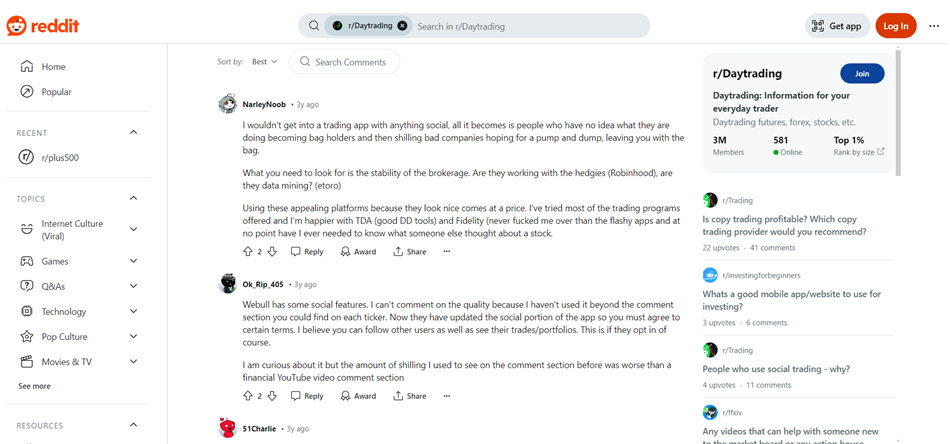
We found a few threads where users were discussing the best social trading apps. While most users praised eToro as the finest alternative for social trading, a few criticized it for its premium pricing and inadequate customer service. For instance, this user preferred TDA and Fidelity rather than eToro.
Quora
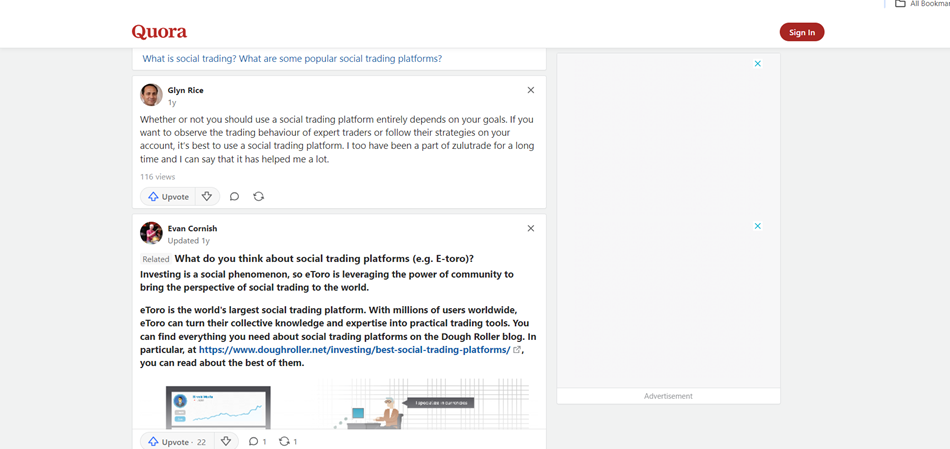
Quora users hold mixed opinions about social trading apps. This user responds to the question of whether to sign up with a social trading app by saying that it entirely depends on your goals. He added that if you want to learn and study the experts, social trading is your way to go.
Bottom Line
Social trading is booming in popularity as more and more people see the value in asking other investors for guidance. Whether you plan to settle down or are just starting out financially, a social trading strategy could be a good option to consider.
In this detailed piece, we covered everything about the best social trading apps and the factors needed to consider while choosing the platforms, such as user interface, trading conditions, fees and commissions, and many more. We also delve into the popular assets investors trade on these apps.
While social trading forums do provide some good information, potential investors should still do their own homework before putting their money into it. What are your thoughts and experiences on social trading apps? Don’t hesitate to share them in the comments.